

Let’s face it, aging is inevitable. There are some factors of aging that we can control, like wearing SPF daily but there are other hereditary factors that we cannot change. The more you consistently take care of your skin and health, the better results you will have! Based on client feedback, many of you are interested in an anti-aging skincare routine. When it comes to anti-aging there are tons of skincare products to choose from. We know this can be a bit overwhelming so here’s some of our favorite anti-aging ingredients to get you started!
1. Sunscreen, sunscreen, SUNSCREEN!
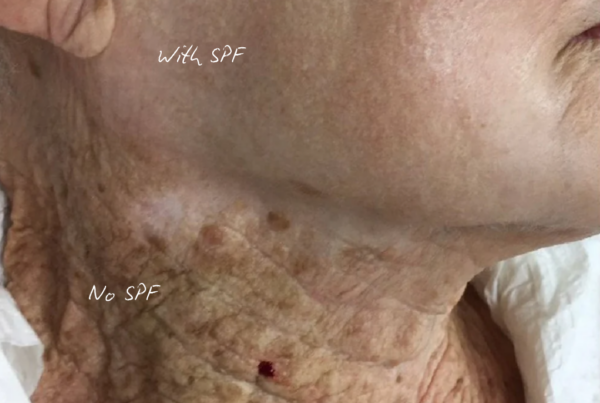
It’s a no-brainer that the sun is the number one cause of premature aging. The good thing is, it’s also something that we can control. Wearing an SPF and reapplying throughout the day and year round (even during the winter) plus staying out of the sun as much as you can is key- your skin will thank you! Love the post-sun glow? Try a sunless tanner and stay out of tanning beds!
2. Retinol
Retinoids are forms of Vitamin A which occur naturally in foods we eat such as broccoli and carrots. We transform these vitamins into active ingredients for topical use. Retinols (a type of retinoid) speed up your skin’s cell-turnover process to help increase collagen production. This in turn improves the appearance of fine lines, wrinkles, texture, and pigmentation.
This ingredient is also beneficial in treating adult acne, and most adult breakouts and texture are caused by a buildup of dead skin cells, since that process slows down over time.
The downside of retinols is that they may be irritating to the skin when they are initiated. Starting low and slow allows your skin to acclimate to the active ingredient and become more tolerant of its effects.
If your skin is sensitized and retinols just aren’t your friend, a good natural retinol alternative is bakuchiol! It’s less irritating and a good introductory ingredient that offers the same anti-aging benefits.
3. Vitamin C
One of our favorite antioxidant ingredients, Vitamin C, protects against free radical damage from everyday pollutants. After long term use, Vitamin C can brighten the skin and reduce the appearance of dark spots. There are many Vitamin C serums in the market but it’s important to look at the concentration. A lower concentration (around 5%) may take longer to see results, while a stronger formulation (20%) may have faster, more noticeable results. A Vitamin C derivative with a lower concentration to look for is ascorbic acid.
Vitamin C supports the absorption of subsequent products such as SPF and even retinols. Like a great teammate, the synergy of Vitamin C when combined with other team members (aka ingredients) yields even better results. Research has shown that Vitamin C adds protection against UVB damage and allows for longer lasting broader sun protection when combined with UVB sunscreen ingredients. Also, when combined with retinols provides an even stronger absorption.
4. Niacinamide
Niacinamide, also known as Vitamin B3, improves rough, dry, or flakiness, helping to smooth and improve suppleness of skin. It also improves the appearance of fine lines and wrinkles and even skin’s complexion.
5. Hyaluronic acid
Hyaluronic acid regulates general skin activity, such as water absorption, elasticity and distribution of nutrients to the skin making it an ideal base for subsequent products to penetrate better. Its water absorption abilities and large molecular structure allow the epidermis of the skin to achieve suppleness and moisture that it craves!
6. AHA/BHAs
AHAs/BHAs are chemical exfoliators. The most common are glycolic, lactic, and salicylic acids. By exfoliating dead skin cells and getting rid of buildup in pores from oil, pollutants, and debris, the look of fine lines/wrinkles, roughness, and tone of the skin is improved.
Glycolic acid is an alpha-hydroxy acid (AHA) that helps improve the look of fine lines/wrinkles, brighten. Lactic acid is a gentler, AHA, that works the same to chemically exfoliate but has less risk for irritation. Salicylic acid is a beta-hydroxy acid (BHA) that helps to dissolve the top layer of dead skin cells and reduces sebaceous follicle blockage (aka clogged pores) through oil-soluble chemical exfoliation.
A skincare routine is normally done twice a day: once in the morning and once at night. A good daily anti-aging morning routine includes a cleanser, a Vitamin C or other skin condition specific serum, a light moisturizer, and finishes off with your favorite SPF. A daily anti-aging nighttime routine includes a double cleanse (the first cleanse to remove your makeup, oil, and debris from your day and the second cleanse is to cleanse the skin), a skin condition specific serum, and finishes off with a rich, hydrating moisturizer. Want to take your skincare to the next level and have the extra time for a correction step? Try an exfoliator, a mask, or heavy duty retinol 2-3 times a week!
Another common question we hear: how do I know in what steps to apply my skincare? Think of the order of your skincare as thinnest to thickest! Your thinnest serums and oils are then followed by your thickest and most hydrating moisturizers.
Have additional skincare questions? Schedule your consultation with one of our providers. We can’t wait to see you in the studio, gorgeous!
Source: Michalun, M. V. Dinardo, J. C. (2015). Skin Care and Cosmetic Ingredients Dictionary, Fourth Edition. Milady.